I Went to the Shelter to Adopt a Dog and Start Over. But in the Last Kennel, a German Shepherd Pushed a Dented Bowl Toward Me — and I Knew That Sound.
I Went Alone That Morning
There was no child with me that day.
I went alone, because I wanted the decision to be mine.
I was forty-one, two years back on my feet, in a rented house with a fenced yard.
I was ready for a dog again.
I walked the hallway slowly, past the barking and the bright young faces, telling myself I would know the right one when I saw it.
I stopped at the last kennel without knowing why.
The Last Kennel
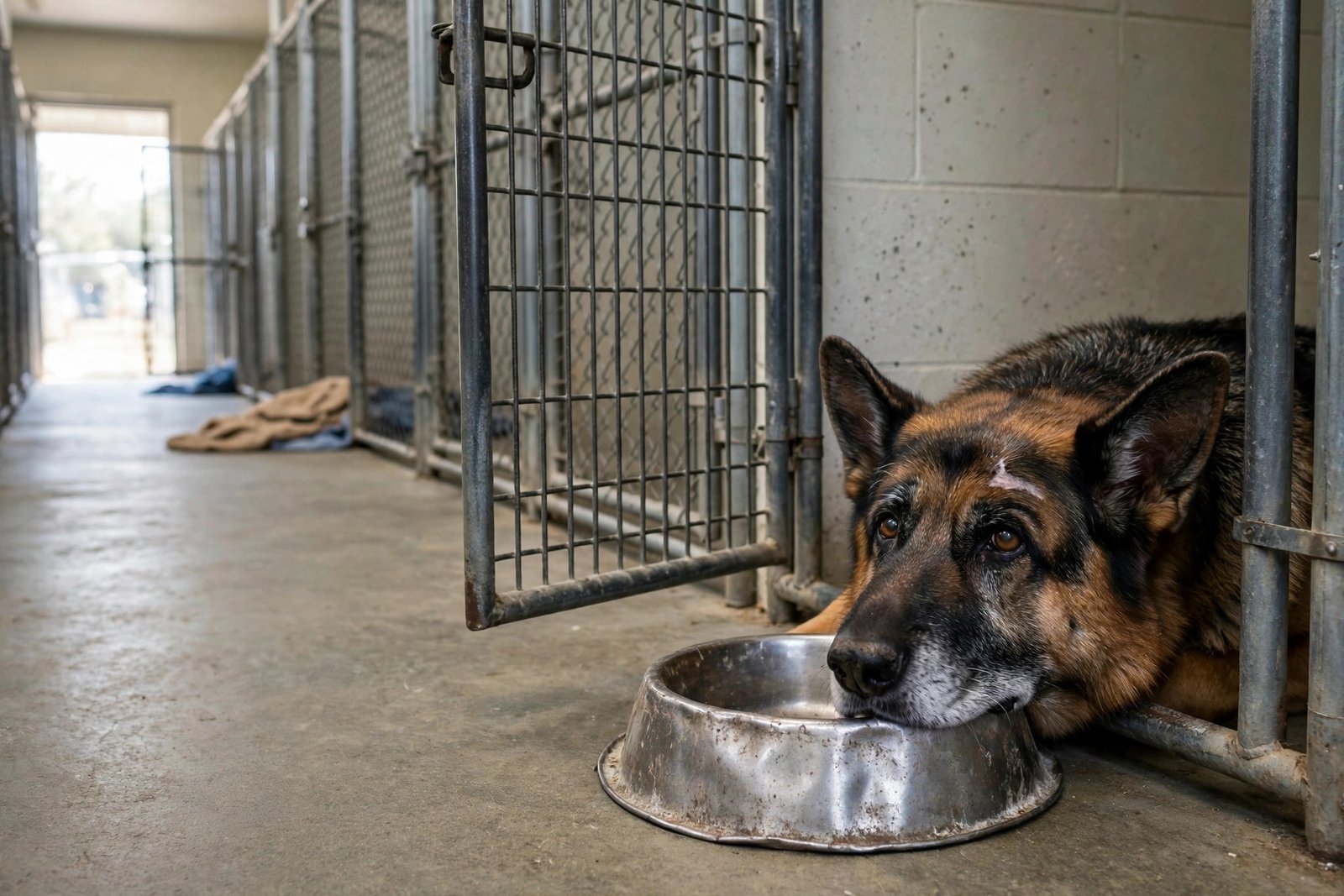
A German Shepherd lay on the concrete with his chin resting on the rim of a metal food bowl.
The bowl was dented on one side, bent almost flat.
He wasn't barking.
He was watching the bowl, the way a man watches a door he expects to open.
A worker came up beside me.
"That's Rex. He's been here five years."
I turned.
"Five years?"
"On and off," she said. "Adopted twice. Brought back twice. He came in the last time with that bowl, and he won't eat out of anything else."
She told me the rest while I stood there.
He slept with his chin on it.
He carried it from one end of the kennel to the other when he was restless.
If a new bowl was put down, he flipped it over and sat by the dented one until someone understood.
I Knew That Dent
I looked at the dog again.
The ears.
The dark saddle across his back.
The small white scar above one eye, shaped like a comma.
And then the thing that stopped my breathing.
The dent.
I knew that dent.
Six years ago I had a dog, and when I fed him in the mornings, he would finish, pick up his bowl in his teeth, carry it across my kitchen, and drop it at my feet.
Clang.
Every morning.
Clang — meaning more.
Clang — meaning walk.
Clang — meaning I am here, and so are you.
One winter morning I stepped backward in the dark and came down on that bowl with my full weight. It folded under my boot. He picked it up anyway, dented, and dropped it again.
Clang.
The Winter I Lost Everything
Six months later I lost my job.
Then the apartment.
Then, piece by piece, the life that had a kitchen in it.
I slept in my car for eleven weeks with a German Shepherd in the back seat, and I fed him before I fed myself, and I told myself that love was enough.
It wasn't enough.
A dog that size cannot live in a car through a winter, and a man who loves his dog does not ask him to.
So I drove him to a shelter two counties away, because I could not watch anyone I knew carry him inside.
I signed the paper with a hand that would not stop shaking.
I left him with his bowl.
I told the woman at the desk, "He likes to carry it. Please let him keep it."
Then I walked out, and I did not look back, because looking back would have finished me.
I got sober two years later.
I got work.
I got the little house with the fence.
And some nights, standing in my quiet kitchen, I still heard it.
Clang.
The Calls That Stopped
The worker was watching my face.
"Would you like to meet him?" she asked.
I couldn't answer.
She unlatched the kennel door and swung it fully open.
Rex stood up slowly. He was gray around the muzzle now, and careful on his back legs.
He picked up the dented bowl in his teeth.
He carried it the length of the kennel.
And he set it down in the open doorway, at my feet, and pushed it once with his nose so that it rocked against my shoe.
Clang.
Soft.
But the same sound.
My knees went.
I sat down on the shelter floor and put my forehead against the top of his head while he stood there, patient with me, the way he had always been.
"Rex," I said.
His whole body leaned into mine.
Not wagging wild. Not barking.
That lean, like a wall deciding to stay.
The Question I Was Afraid to Ask
The worker spoke carefully.
"He was adopted the same year he first came in. The family moved overseas. The second family said he was too quiet. He kept waiting by their door with the bowl."
I looked up at her.
"Did anyone ever call here asking about him? Years ago. A man who called every week for a while?"
She shook her head.
"The calls stopped after the first year."
The calls stopped because the man making them had been sleeping in a shelter by then, and had run out of quarters and courage.
I had stopped calling because I believed he was happy somewhere, and my voice on the phone was the only thing that could ruin it.
All this time, he had been two counties away.
Keeping the bowl.
Waiting by doors.
I put both hands around that dented bowl and held it like it was made of glass.
"I need to know something," I said. "When he was brought back the last time — did the family say why? Did they leave anything? A note? Anything at all?"
"Just the bowl," she said.
Five years he had been carried in and out of homes, and the only thing that ever traveled with him was a bowl I had stepped on in the dark.
We had come to that hallway from opposite ends of six lost years.
I had come to start over.
He had never started anything. He had only waited.
I looked at the bowl at my feet, and at the old dog leaning against my shoulder, and I understood the question I was afraid to ask was not about the families who brought him back.
It was about the man who drove away.
The Rest of the Story
This is the part the reel could not carry — the part that only lives here.
I did not sign anything that day.
I wanted to. Every part of me wanted to grab the leash and run. But the man who drove away six years ago did not get to undo six years in one afternoon, and Rex deserved better than my guilt.
So I asked the worker the question that mattered.
"Is he mine to ask for? Or does he deserve a better family than the one who left him?"
She looked at the dog, then at me, and she did not flatter me.
"He's been waiting by doors for five years," she said. "Maybe he was waiting for this one. But you prove it the slow way. Come back tomorrow. And the day after. If he still chooses you on the third day, we'll talk about paperwork."
So I came back.
Three days. Then a trial weekend. The shelter checked the fence, the house, the vet I had already chosen. Rex was examined — stiff hips, a heart that needed watching, nothing that love and routine could not carry.
On the trial weekend, he walked my hallway the way he had walked the kennel: slowly, chin low, checking every door.
And then he found the kitchen.
He set the dented bowl down in the middle of the floor.
He looked at me.
And he waited.
What the Sound Means Now
The first morning, I fed him before I fed myself.
Old habit. The right one.
He finished, picked up the bowl in his teeth, carried it across my kitchen, and dropped it at my feet.
Clang.
It did not sound like goodbye anymore.
It sounded like breakfast.
Like a walk.
Like I am here, and so are you.
Rex sleeps by the back door now, the dented bowl beside his bed. Some nights he still carries it from room to room when he is restless, and I let him, because some habits are not problems to fix.
They are proof that something survived.
Six years ago I stepped on that bowl in the dark and thought I had broken something.
It turns out the dent was the only part that never left him.
And the only part that brought him home.